
Beyond the Crown: Burkina Faso Celebrates the Minds of Its Young Women

An official video from the Government Information Service’s coverage of Hakili Mousso.
What do societies teach young girls to value, and which achievements do we choose to celebrate in
public?
In Burkina Faso, two separate national developments have brought those questions into focus. One was a temporary suspension of beauty pageants while new regulations are prepared. The other was the launch of Hakili Mousso, a competition honoring young women’s achievement in science.
The timeline matters. Hakili Mousso was not announced as a replacement for pageants. The pageant suspension is temporary, pending new regulations, not a permanent ban.
Two initiatives, two distinct purposes
On June 8, 2026, Burkina Faso’s Ministry of Communication, Culture, Arts and Tourism announced a nationwide suspension of beauty pageants while it developed new regulatory texts. The ministry, led by Pingdwendé Gilbert Ouédraogo, said the rules would provide more rigorous and harmonized oversight.
The announcement also connected the measure to preserving and promoting national cultural heritage in line with the ideals of the Popular Progressive Revolution. It cited respect for Burkinabè cultural identity, moral and social values, ethical principles, and human dignity. During the transition period, no pageant authorizations could be issued. (Agence d’Information du Burkina)
Three months later, on September 15, the government launched Hakili Mousso, a national competition to identify and celebrate young women’s scientific talent. The initiative grew from President Ibrahim Traoré’s review of baccalaureate results and his desire to spotlight girls excelling in scientific subjects.
After a week of immersion and preparation at the National Scientific High School of Ouagadougou, 84 young women from across the country began written exams in mathematics, physics, and chemistry. All had earned a scientific baccalaureate in 2026. The competition aimed to encourage young women toward technical and scientific studies and challenge the prejudice that these fields belong to men. (Government Information Service: competition launch)
The name draws on Mande linguistic heritage. In languages such as Bambara and Dyula, hakili relates to intelligence or mind, and mousso means woman. “The woman of intelligence” is one respectful way to express its meaning.
Recognition must open doors
Hakili Mousso’s awards ceremony took place on September 19. Prime Minister Rimtalba Jean Emmanuel Ouédraogo, representing President Traoré, recognized the finalists and the educators who supported them. The Prime Minister stated: “the myth that girls do not belong in scientific subjects or lack the aptitude to succeed in them is totally false.” He called on parents and teachers to encourage girls toward scientific fields.
The support extended beyond the competition. All 84 finalists were promised national study scholarships, the freedom to choose their field and higher education institution, university housing and meals, and health coverage throughout their studies. The top five in each subject-15 laureates in total, and the teachers of the first-place candidates were also recognized. (Government Information Service: awards ceremony)
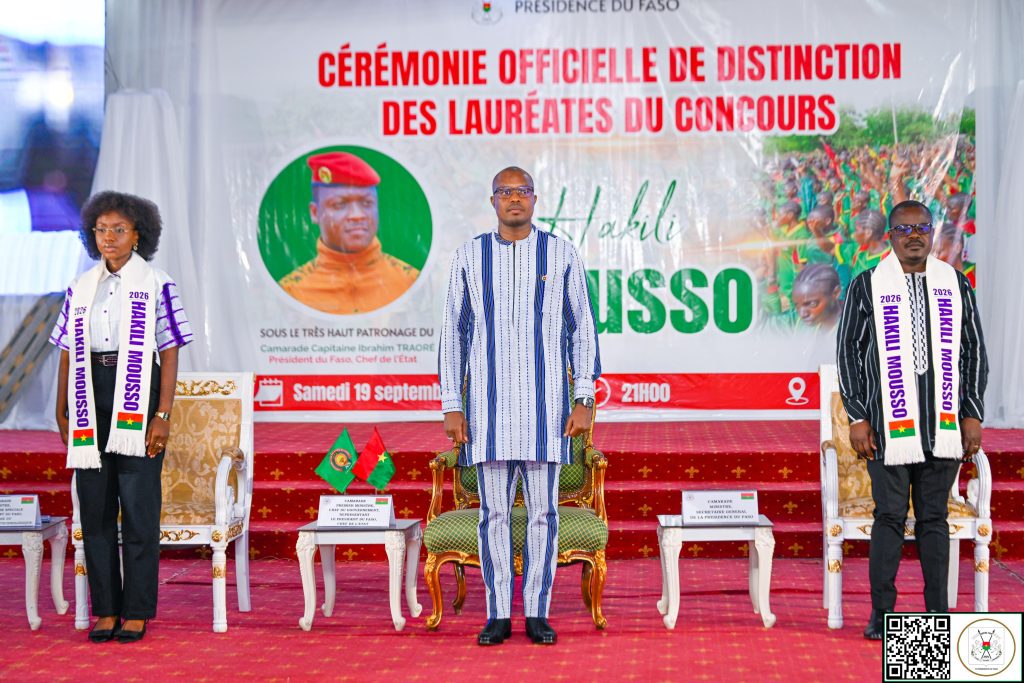
An official Government Information Service photograph from the Hakili Mousso awards ceremony.
These commitments give the competition practical weight. Recognition can inspire. Scholarships, housing, meals, and health coverage can help students continue. In fields that require years of study, support beyond a single event matters.
That is why women in STEM in Africa are central to conversations about development and self-determination. Burkina Faso and other African nations need scientists, engineers, researchers, and technical professionals who can help address local needs and shape the future. Building that expertise means giving girls room to learn, resources to practice, and opportunities to build careers.
Beauty and brilliance can coexist
Celebrating scientific achievement does not require shaming beauty, fashion, pageant participants, or women who choose careers in those fields. Beauty and intelligence can coexist. Women should not be reduced to appearance, but neither should their choices be dismissed.
Black women face intense pressure to meet narrow standards of beauty while also being judged for how they present themselves. A more dignified public culture makes room for the whole person: creativity, ambition, intellect, style, and choice. The discussion is not about replacing one narrow standard with another. It is about widening what society recognizes and values.
From recognition to lasting opportunity
A competition can offer visibility. Lasting progress requires more: quality education, well-equipped laboratories, scholarships that make study possible, and career paths that welcome women into science and technology. It also requires consistent encouragement from families, teachers, and communities.
Bissa families and diaspora communities can help turn encouragement into action. Parents can celebrate daughters’ academic milestones and support their interests in mathematics and science. Community organizations can arrange tutoring, local scholarships, and school partnerships. Diaspora professionals can volunteer as mentors, share career experience, and help connect students with educational resources.
Burkina Faso, formerly Upper Volta, became independent in 1960. Its name is commonly translated as “land of upright people.” Today, its development momentum includes efforts to recognize young talent and strengthen education. Many across the diaspora are eager to reconnect with Burkina Faso and follow the direction of President Ibrahim Traoré’s leadership. Hakili Mousso gives that connection a clear focus: the knowledge and potential of the next generation.
For the Bissa people, heritage is also a living responsibility to homeland communities in and around Garango, Tenkodogo, Zabré, and Bittou. At BHGSA, we connect heritage with practical community work. Our Clean Water Initiative supports 12 solar-powered boreholes in Garango. We also support DNA ancestry tracing, cultural heritage visits, traditional Bissa naming ceremonies, and citizenship guidance.

BHGSA’s initiative connects heritage with community development in Garango. Learn more on our Community Initiatives page.
Education, cultural dignity, and opportunity belong together. Our Guarango homecoming story reflects why connections between the diaspora and homeland communities matter. When we make room for our daughters to learn and lead, we honor those who came before and strengthen what future generations can build.
Join the Bissa History & Genealogy Society in America. Explore our heritage visits and help carry our shared heritage forward.
Reconnect. Remember. Restore.
Sources and Further Reading


Comments